 |
| Notes Anecdotes La Fin / The End |
Notes complémentaires
Additional notes
Chiefs
of Staff
Commanders and Chiefs of Staff
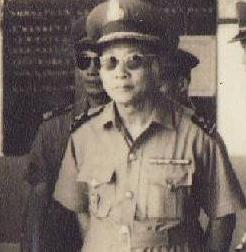
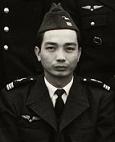
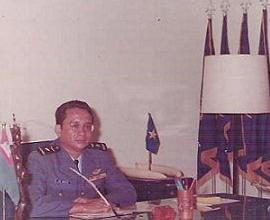
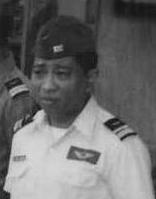
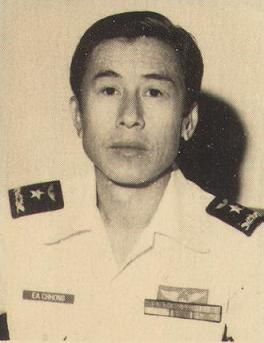
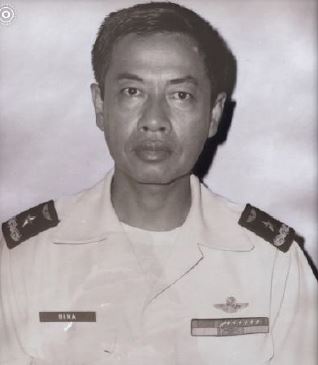
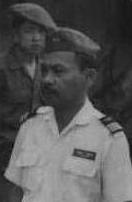
Dans l'Armée de l'Air du Cambodge de la République Khmère, seuls les chefs d'état-major successifs ont été promu au grade de Général. Ce n'est que durant la dernière année que le sous-chef d'état-major fut lui aussi nommé Général. Quand Phom-Penh tomba, l'effectif était d'environ 10 000 hommes commandés par deux Généraux. In the Cambodian Air Force of the Khmer Republic era, only the Chief of Staff had been promoted to the rank of General. It is only during the last year of the war that the Deputy Chief of Staff was also appointed General. When Phnom-Penh colapsed, two Generals commanded 10,000 airmen.
|
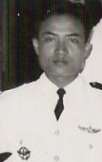
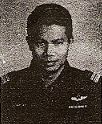
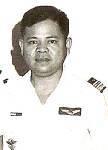
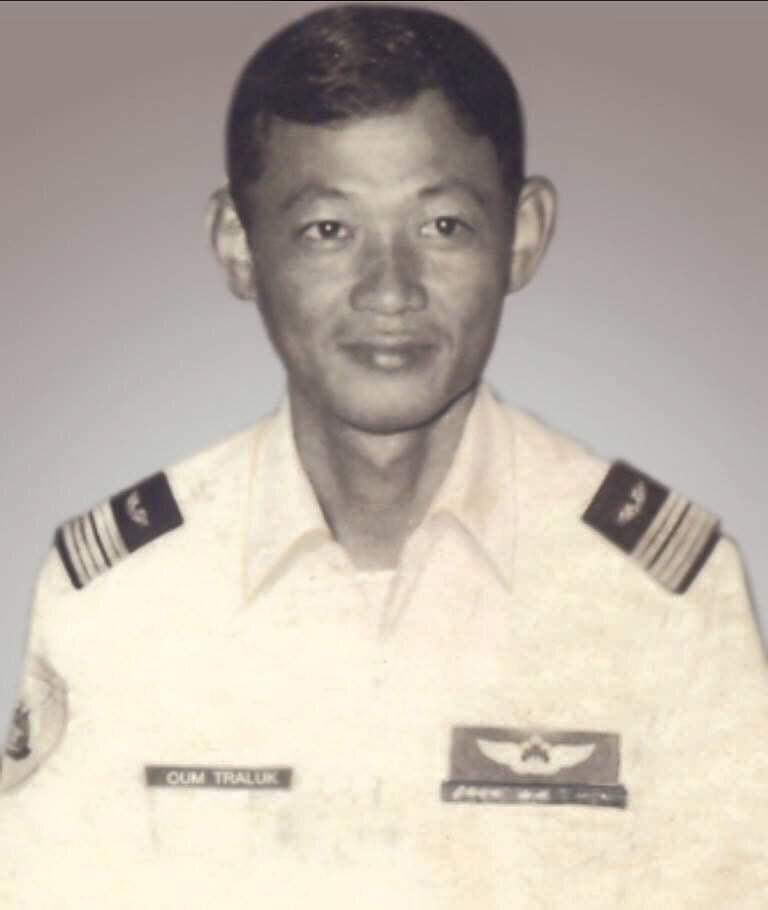
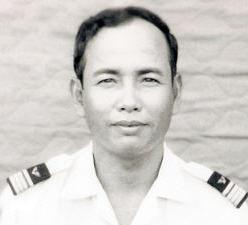
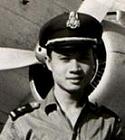
| 1970 'Le Commandant de Bataillon'
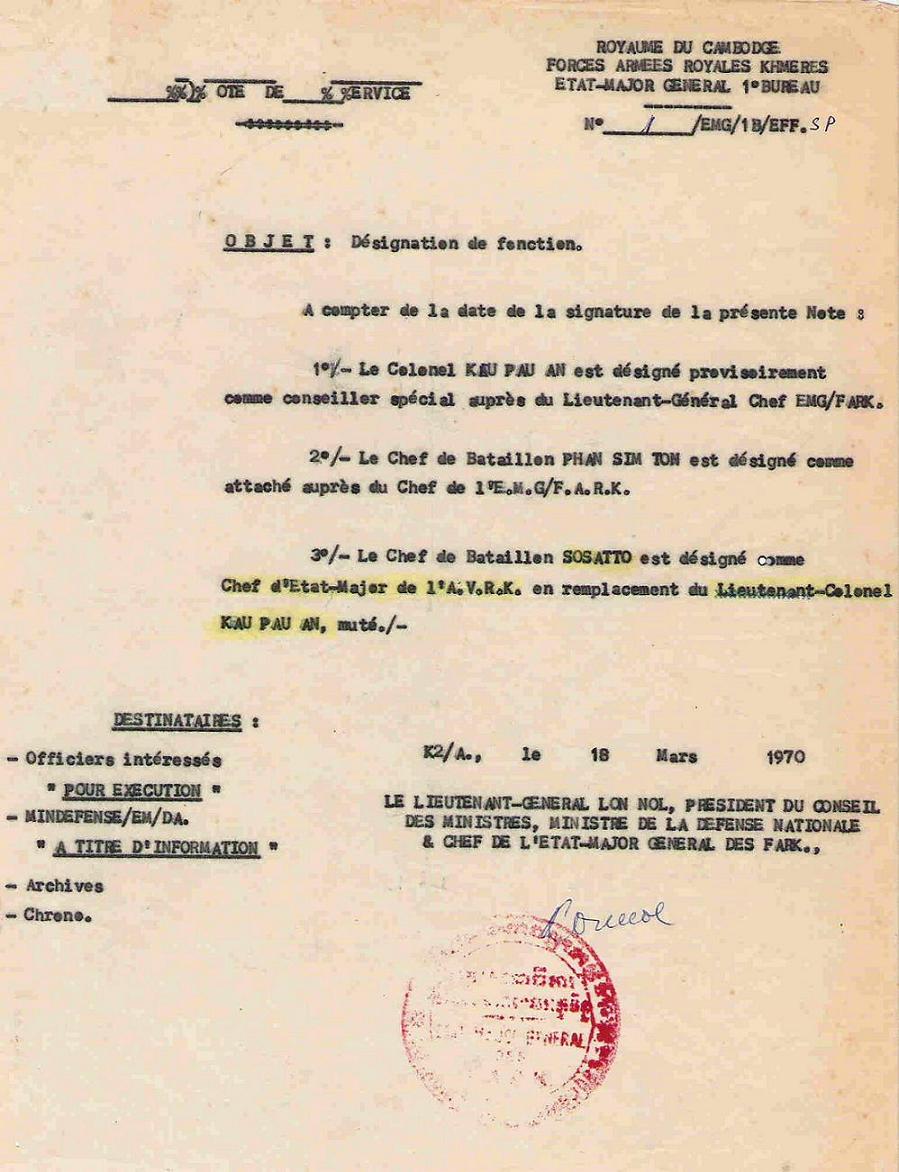
Il est à noter que jusqu'à présent, un Commandant de l'Aviation est assimilé à un commandant d'une unité relevant de l'Armée de Terre. 1970 The 'Battalion Commander' In the attached decree, one can notice that up to that time, an Aviation Major was still officially referred as a battalion commander, reporting in some way to the Army. S.SO |
|
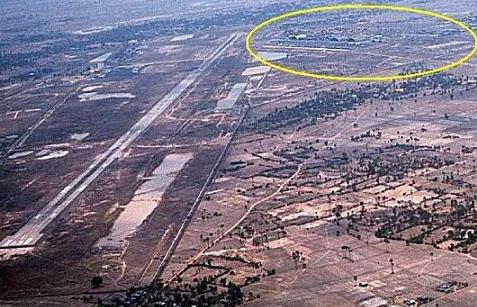
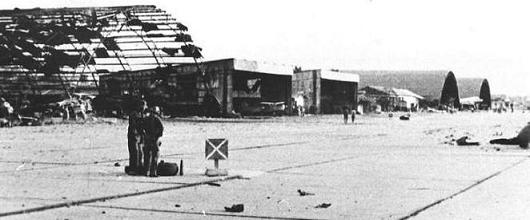
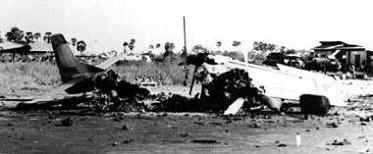
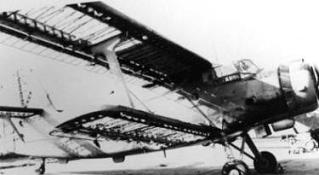
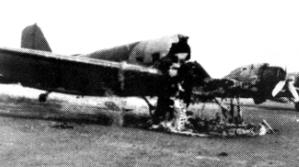
First, near the civilian airport, an Army transport center and an ammunition warehouse were attacked. It was a diversion. Right after the first explosions, the Vietcong cut the barbed wires and penetrated into the military airport zone on three points; This was found out later. At the very moment, nobody knew where the Vietcong came from, which would be their targets nor if this would be the prelude of a general attack. Due
to the lack of experiences, it was a total surprise.
Only some guardrooms were equipped with telephones. It was outdated cable crank telephone sets. In
the whole Air Base, there were less than a hundred rifles. Apart from a
few French MAT-49 submachine guns, the rest was the action-bolt
World War II French MAS-36 rifles. When the Vietcong appeared on the
tarmac, the mechanics and the guards were mainly equipped with sticks.
With their AK47s, the Vietcong easily cut them down. In offices,
the ‘day officer’ Cne Youk Sam Ann was
one of rare to have a rifle at hand. He killed a Vietcong who venture
into to offices and wounded another one who ran away. In fact, this commando group targeted exclusively at
planes and at the tarmac area. The accommodation area for the
servicemen and the families were fortunately not touched. However,
the guards of that sector held their positions and as a precaution, pilots were evacuated to shelters.
A coté de l'aéroport civil, un centre de transport et un dépôt de munition de l'Armée de Terre furent attaqués en premier. Dès les premières explosions, les vietcongs avaient coupé les barbelés et ont pénétré dans la zone militaire sur trois points; cela fut constaté ultérieurement. Sur le coup, personne n'a su d'où ils venaient, quelles seraient leurs cibles ni si cela ne serait que le prélude d'une attaque plus générale. Par manque d'expérience, la surprise fut totale. Seuls quelques postes de gardes étaient équipés de téléphones. Il s'agissait de téléphones filaires à manivelle. Dans toute la base aérienne, il n'y avait que quelques pistolets mitrailleurs MAT49 et moins d'une centaine de fusils. Tous, de vieux MAS 36 qui ne tiraient qu'au coup par coup. Quand les vietcongs surgirent sur le parking des avions, les mécaniciens et les gardes dont certains équipés de simples bâtons, ne firent pas le poids. Dans les bureaux, le Cne Youk Sam Ann, 'officier de jour', était un des rares à avoir un fusil. Il descendit un vietcong qui s'aventurait dans les locaux et blessa un autre qui s'enfuyait. En fait, ce groupe de commandos ne visait exclusivement que les avions et le tarmac. Toutefois, les gardes du secteur des habitations tenaient leurs positions et par précaution, les pilotes qui dormaient ce soir là à la base sont envoyés vers des abris.
Seulement
quatre Vietcongs furent tués mais des blessés laissèrent de nombreuses traces de sang pendant leur repli. A
l'aube, les quelques avions d'observations épargnés localisèrent les éléments retardataires. Ils se
repliaient en direction de Amleang. Les avions et les hélicoptères (Cobras) américains
arrivés en renfort les ont attaqués aux abords d'une rizière. Plusieurs autres furent rattrapés par des Khmers Krom de la 'Mike Force'. La quinzaine
de
corps retrouvés portaient tous des ceintures
avec des étuis pour explosifs. Les vêtements de beaucoup d'entre eux
sentaient extrêmement mauvais. Dans tous les cas, une partie du
commando réussit à s'éclipser même si plusieurs autres
groupes
de Vietcongs furent rattrapés dans les jours qui suivirent. Pour venir,
ils avaient réussi
à traverser le périmètre de la "RMS" : la Région Militaire Spéciale de
l'Armée de Terre autour de Phnom-Penh. Les Vietcongs avaient
l'expérience d'audacieuses attaques
de bases aériennes américaines et avant, des bases aériennes françaises. Fort heureusement, les pilotes, si longs à former et si peu nombreux en ce début de guerre, ne figuraient pas parmi les victimes. Les vietcongs auraient pu immobiliser l'AVNK pendant non pas une ou deux semaines, mais six mois à un an, le temps que de nouvelles promotions soient formées. Très rapidement, les américains livrèrent de nouveaux avions pour rééquiper l'aviation. Par la suite, quand l'Aviation fut devenue indépendante de l'Armée de Terre, l'infanterie de l'Air sera renforcée de plusieurs régiments. Elle assurera elle-même la sécurité de ses bases sur un périmètre élargi. Les Etats-Unis assuraient leurs équipements et des unités furent même envoyées en formation dans les bases américaines. |
|
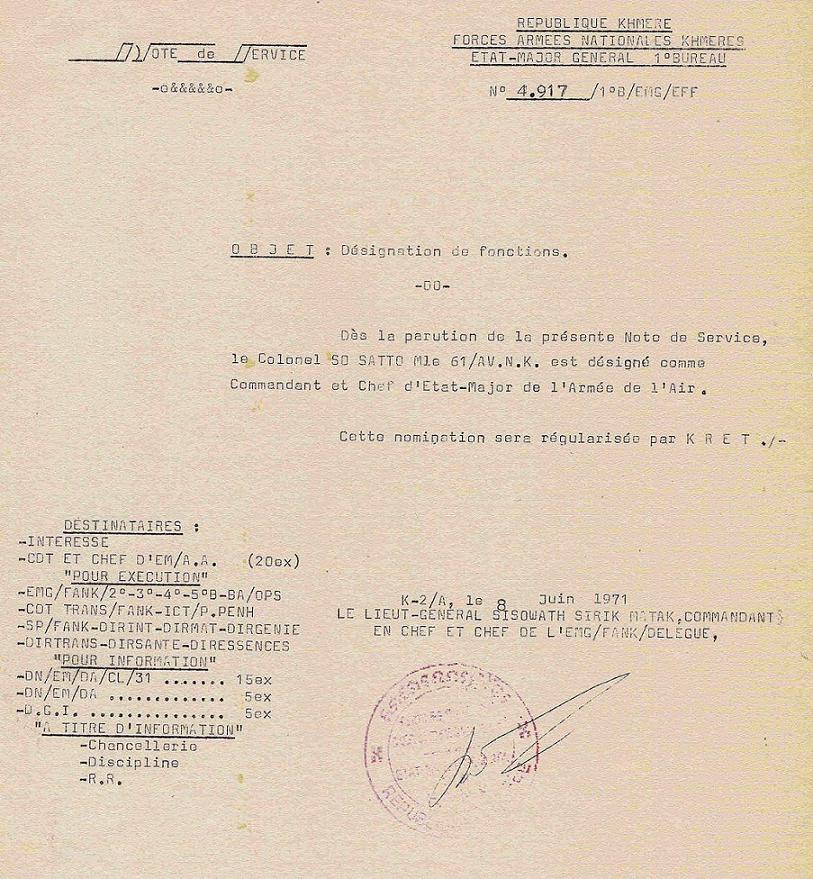
1971 De l'Aviation à l'Armée de l'Air 1971 From the Aviation to the Air Force Before June 8th, 1971, the Military Aviation was in a way a sub-command of
the Army. Any senior officer appointment was subjected to approval from
the Army. For a given operation, the Army fixed for instance, the
number of helicopters to transport troops but also a number of
helicopters for the transport of the Army headquarters officers. This
rigid approach which not take in count the specificities of the AVNK in
term of technical needs as well as the correct use of its aircraft
posed problems. With the increasing responsibilities allowed to the
AVNK, linked to its expansion in term of new aircraft and squadrons,
led to numerous disputes on the decisions to take with the Army. We
judged necessary to apply, not without difficulty, for a complete
autonomy of the Aviation. S.SO |
|
Dans
un pays instable, une Armée de l'Air peut être ressentie comme
potentiellement dangereuse. Un pilote peut commettre un attentat ou
bombarder un palais présidentiel. Toutefois, les effectifs
et la faible dissémination des installations d'une Armée de
l'Air ne lui permet pas de prendre le pouvoir et
encore moins de le garder. En
revanche, elle peut arrêter les débordements
personnels et aventureux de certains chefs militaires
ambitieux. Dans une certaine mesure, elle réduit la
'Toute Puissance' des militaires en évitant que celle-ci ne soit
pas entre les mêmes mains. Une Armée de l'Air peut être
un des garants de
la démocratie. In
1971, the Head of state Lon Nol was hospitalized at Hawaii further to a
serious stroke. Two weeks after his departure, a military leader very
close to him wanted to initiate a coup against Prince Sirik Matak,
President of the Minister’s council and interim Commander of the Armed
Forces. In an unstable country, an Air Force can be felt as potentially dangerous. A pilot can commit an attack or drop bombs on the Presidential Palace. However, the limited and scattering number of the Air Force installations as well as the small number of its personnel do not allow it to take the power. And it is even more difficult to keep it. On the other hand, an Air Force can stop the adventurous ambitions of some military leaders. To a certain extent, an Air Force contributes to reduce the concentration of power of the armed forces by avoiding this power to be in one and unique hand. An Air Force can even be one of guarantors to the democracy. S.SO
|
|
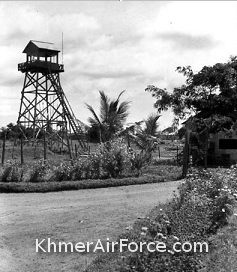
En
1971, l'activité aérienne militaire et civile à
Phnom-Penh s'est considérablement accrue. Malgré la
délocalisation de l'Ecole de l'Air à Battambang, tôt
ou tard, de nouvelles pistes, de nouveaux taxiways, des
élargissements ou des prolongements, s'avéreront
indispensables pour décongestionner les attentes et les
manoeuvres au sol des avions. Des gros porteurs, comme les C-5
Galaxie de l'USAF ou surtout les Boeing 747 qui commencent à arriver
sur le marché de l'aéronautique pourront alors
potentiellement atterrir. Or, les possibilités d'extension
pour développer à la fois l'aéroport civil et
l'aéroport militaire sont très limitées à
Pochentong. Par ailleurs, l'axe de la piste donne directement sur
l'antenne nationale de radio diffusion.
Oudong Airfield In
1971, the military and civilian air activities at Phnom Penh had
considerably increased. In spite of the relocation of the Air Academy
to Battambang, sooner or later, new runways and taxiways extensions
would be needed to relieve the air traffic congestion and the
ground manoeuvres of the planes. In those years, wide-body aircrafts
such as the Lockheed C-5 Galaxy and especially the new Boeing 747
started to make their début in the international sky and might
potentially land in Cambodia. Especially, we projected and hoped
that after the war, we would have the required infrastructures
when the tourists would be back again. S.SO
|
|
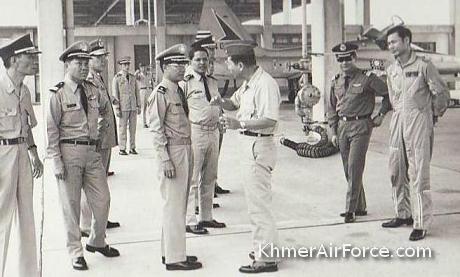
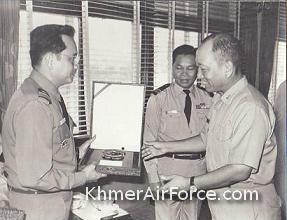
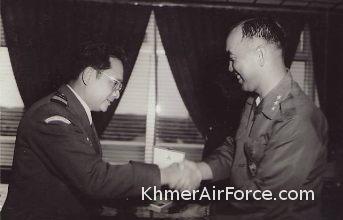
Délégation Inter Arme à Taiwan
Pour
l'AAK, c'était pour finaliser l'accord pour faire venir les
pilotes
instructeurs taiwanais. Cela permet de mettre au point les méthodes de
travail et de collaboration avec les aviateurs taiwanais. Taiwan
prévoyait une aide bien plus importante
pour le jour où on mettrait en place une Ecole de chasse qui était
prévue à la base de
Kampong Chnang. Plusieurs milliers de tenues nous a aussi été données.
|
  |
|
Military Delegation at Taiwan
For
the KAF side, it was for the final procedure for bringing Taiwanese
instructors. This allow to set up working methods with Taiwanese
airmen.Taiwan agreed for a more substancial aid for the day we
would set a futur fighter school, planned for Kampong Chnang AFB. We also received several thousands of uniforms.
S.SO |
|
| Australian aids
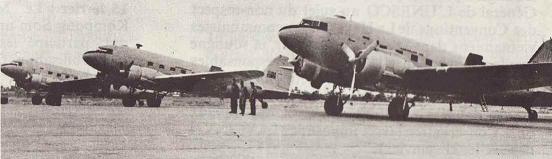
En
plus des six C-47, et à la demande de la KAF, les Australiens acceptèrent
aussi de former des pilotes cambodgiens de différentes spécialisations.
L'Australie émit en outre l'idée d'un partenariat pour la création
d'un centre de révisions générales pour les C-47 mais aussi pour des appareils
plus importants. Ceci permettrait aux mécaniciens et ingénieurs de la
KAF de monter en compétence. Ce centre fonctionnerait sous le statut d'une société privée et serait en partie auto financée
en acceptant la révision des appareils civils de la région. Les
Australiens proposaient Singapour comme base principale de ce futur centre. (mission australienne d'évaluation technique reçue par l'Officier-Ingénieur So Eng Chun).
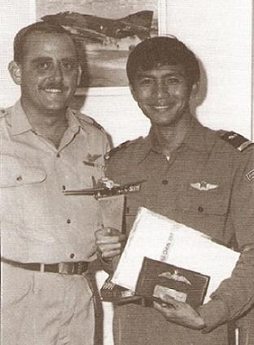
In
addition to the six C-47s handed over to the KAF, Australia agreed to
train Cambodian personnel in various technical specialities,
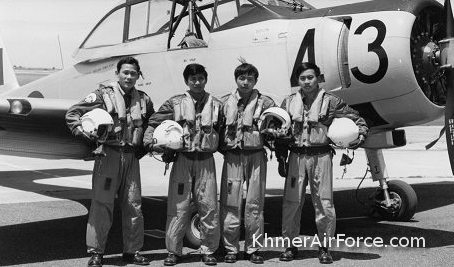
including pilots. The firsts aircrew to attend training with the RAAF
concerned the Officers Ea Y and Ty Theav, send for their
transport aircraft's captain-ship graduations at AF Base East Sale, Victoria. They were followed by a
group of young cadets to attend basic and advanced flight trainings.
Unfortunately, in the middle of their tour, it happened a change of
government in Australia. The new administration, like those in United
States, was no longer on the mood to continue to support military
activities in South East Asia. Australia, unilaterally, decided to
suspend all aids to Cambodia. However, thanks to a "discreet" agreement
arranged by the RAAF, it was decided to nevertheless complete the
advanced training of four Khmer cadets who had just pass through
successfully the basic training courses. It was the last Australian aid
to the KAF, despite that previous discussions suggested more thorough
and ambitious projects. One of them was the set up of a joint
Khmer-Australian maintenance centre for overhauling of the C-47s as
well as other more larger transport aircraft. The purpose of the scheme
was to develop the technical skill of the KAF engineers and mechanics.
The centre was also to serve as a main maintenance hub for military and
civilian transport aircraft operating in the area. It had to function
on a commercial basis, generating revenues that at terms would make it
financially autonomous. The Australians* would be involved in the project
by lending equipments, personnel and taking shares in the company, as well as by setting up a main
logistical centre in Singapore. However, this project was not welcome by the Chief of the US MEDTC, Gen Cleeland. (*Australian technical assessment mission received by Engineer-Officer So Eng Chun) CS |
|
|
Aides américaines Durant
les premiers mois de la guerre, l’AVNK ne recevait pas encore l’aide
des Etats-Unis. Les américains évaluaient encore la situation. Nous
nous débrouillons seul avec notre matériel vétuste. L’aviation
américaine intervenait au Cambodge mais avec son propre planning, en
parallèle de nos opérations et surtout en appui de leurs troupes. A
partir de mi-1970, les militaires américains commençaient à nous livrer
des munitions et du matériel. De façon générale, en 1971, l'assistance
américaine était toujours prête pour des appuis feu avec ses avions. En
revanche, elle était moins enclin à nous fournir des appareils, à moins
de vieux exemplaires F-86 de la Thai Air force ou des C-119 de la VNAF.
Pour nos techniciens qui devaient apprendre l'anglais et
participer aux tours de garde la nuit, la charge aurait été trop lourde
pour maintenir de trop vieux appareils. L’ensemble de l’aide militaire
était dirigé par un officier de l’US Army. Bien qu’il fût assisté de
techniciens de l’US Army Aviation, le matériel n’était pas adéquat.
Tels les compresseurs qui ne correspondaient pas à nos T-28. Il nous a
fallu le démontrer avant de recevoir des conseillers de l’USAF ainsi
que du matériel approprié.
Notre ambition ne correspondait pas exactement à la politique américaine qui, fin 1970, avait déjà fortement réduit ses troupes. Livrer des pièces, des munitions et des appareils usagés est une chose mais aider à créer une armée de l'air est un investissement lourd qui ne peut porter des fruits qu’à moyen et long terme. Or, les États-Unis n’étaient pas venus pour s’installer, mais pour faire désengager l’ensemble de ses troupes du Vietnam. Ils misaient sur le Sud Vietnam pour tenir face au camp communiste après leur départ de l'Asie du Sud-Est; mais aucunement sur le Cambodge. Par exemple, la direction du MEDTC ne voyait pas d'un bon œil la montée en puissance de l'aviation khmère en une Armée de l'air indépendante. En permanence, il nous a fallu faire nos preuves afin d'obtenir le minimum vital mais finalement, notre politique de refus de matériels trop usagés porta ses fruits. Ainsi, des C-123 furent livrés au lieu des vieux C-119 de la VNAF. Nous percevions bien la différence entre la politique américaine et les militaires américains. A titre personnel, la plupart d'entre eux étaient sincèrement à nos cotés. Les Attachés de l'Air américains étaient des vrais compagnons d'armes. Ils n’hésitaient pas à voler sur nos avions. En 1975, l’un d’eux envoya un télégramme d'excuse officiel au Bureau Militaire de la République Khmère à Washington DC, pour la politique menée par l'Amérique. Vous pouvez vous aussi référer aux sites et textes des unités et services américains ayant opéré au Cambodge: MEDTC, Air America, LAMAT, Bird Air, RUSTIC etc...
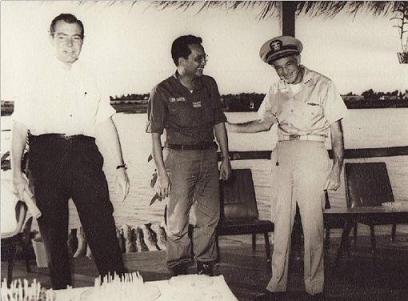
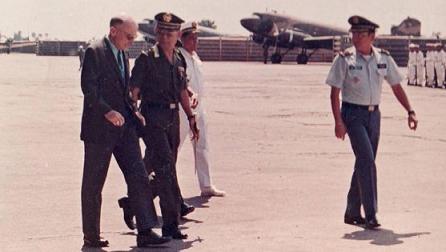
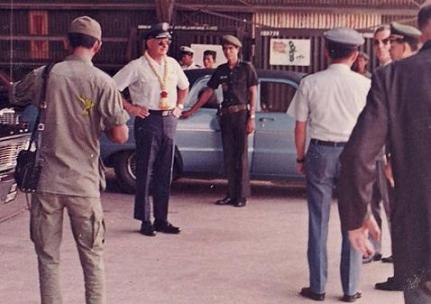
US aids During the first months of the war, the AVNK received no supplies from the USA yet. We were on our own and with our dilapidated airplanes. There were US bombing but it was parallel to our operations. Mid 1970, the US finally delivered us ammunition and materials. Overall, the military assistance was always ready for air strikes but was reluctant to provide new aircraft; except for old Thai F86 and Vietnamese AF's C-119. This was too much workload for our engineers who already had to learn English and guard the installations at night. American aids were at the beginning handled by a US Army officer assisted by US Army Aviation technicians. The material they provided was not always adequate; the compressors did not match the T-28s, etc... We had to prove it before we received USAF personnel and adequate materials. Our ambitious projects were not exactly in line with Washington policy. At the end of 1970, US troops were already drastically reduced. The United States delivered us supplies and ammunition but they were reluctant to help us building a “real” Air Force. They did not come to stay, but to withdraw all its troops from Vietnam. They were counting on South Vietnam to face the communists in South East Asia after their departure, but not at all on Cambodia. For instance, the head of the MEDTC was not pleased to see the Cambodian Aviation become an independent Air Force. We constantly had to prove our capabilities before obtaining the minimum aids; and refusing old materials policy eventually started to bear fruits. Hence, we got the C-123s instead of the old C-119s from the VNAF. We perceived clearly the difference between the US policy and the American military personnel. Most of them sincerely supported us. The Air Attachés at Phnom-Penh were true comrades-in-arms. They often flew within our units. When Cambodia fell, one of them sent an official telex to the Khmer Republic Military Bureau at Washington DC: he was sorry for the US policy. You can also refer to websites and texts of US units and agencies that operated in Cambodia : MEDTC, Air America, LAMAT, Bird Air, RUSTIC etc... |
US Training Schools - Penscola Most of the KAF personnel that came to the US for trainings went to the US Navy Pensacola airbase but others attended other US military center such as the USAF Maxwell Air University, Alabama USA. We will complete the list later. Below list is from LCDR Richard Bergren, US Navy He compiled various US Navy files and documents, such as travel orders, ID cards, rosters, and flight reports. More information was gathered through correspondence and phone conversations he had with some of these former officers, now living in the US. KAF Class 8A (all were First Lieutenants when in Pensacola) Sem Van Phou (KAF ID number: 1663A) 24 April 1973 to 27 Aug 1974 Was living in Illinois in 1981 Ouy Mony (KAF ID number: 1800A) 24 April 1973 to 27 Aug 1974. Was living in Alabama in 1981, now living in Virginia Samreth Poun (KAF ID number: 1909A) 24 April 1973 to 26 June 1974 Was in Illinois in 1981. Toan Chay (KAF ID number: 1879A) 24 April 1973 to 16 March 1974 Escaped to Thailand. He died in Cambodia 20 Sept 2003. Chhor Eang Kong (KAF ID number: 1775A) 24 April 1973 to 22 Jan 1974. Stationed at Phnom Penh at time of Communist takeover. Presumed KIA 1975. Tes Chhum Loeur (KAF ID number: 1821A) 24 April 1973 to 15 November 1973. Was killed in action (KIA) in his UH1H at Kompong Chhnang Air Base, 17 April 1975. Sarun Tith (KAF ID number: not known) Not in US Navy records. Was a KAF Helicopter Pilot trained by the US Army at Fort Rucker, Alabama. He died at age 72 in April 2018 in Lynn, MASS. KAF Class 8B (Second Lieutenants while in training in Pensacola) Tum Chan Thon (KAF ID number: 2123A) 12 Sept 1973. Had an issue with his passport the day he departed. This delay caused him to be still in the US when Cambodia fell to the Khmer Rouge. Siv Bunnareth (KAF ID number: 2112A) 24 April 1973 to 16 March 1974. Returned with Toan Chay to Cambodia and is presumed KIA 1975. Sok Meng Chhorng (KAF ID number: 2110A) 12 Sept 1973. He was first disenrolled from flight training due to vision problems and was issued glasses to correct his vision. Returned to Cambodia but with a delay because of an expired passport. Presumed KIA 1975. Chea Leang Heng (KAF ID number: not known) Listed only on a set of orders indicating Language School. No record of Navy Flight Training. Living in the USA KAF Class 9 (All 2nd Lieutenants) Tang Duc Ve (KAF ID number: 4327A) 12 Sept 1973. Returned to Cambodia 27 August 1974. Living in Mountain View, California in 1981. Ho Satharath (KAF ID number: 4299A) 12 Sept 1973. No record of departure. Living in Long Beach, California 1981. Chau Tunh (KAF ID number: 4293A) 12 Sept 1973. Returned on 18 Sept 1974. Believed to be living in Gainesville, Florida in 1981 Suy Chun Y (KAF ID number: 4319A) 12 Sept 1973. Returned to Cambodia after Language School due to illness about December 1973. Presumed KIA 1975 Chhak Sokha (KAF ID number: 4290A) 12 Sept 1973. Completed Navy Flight Training on 6 Dec 1974. Delayed in leaving the US on 9 January 1975, due to an expired passport. Living in Alabama 1981. Ros Si Ngam (KAF ID number: 4316A) 12 Sept 1973. Completed flight training at Fort Rucker. Alabama in 1981. Sok Nol (KAF ID number: 4317A) 12 Sept 1973. Completed Navy flight training on 9 January 1975. Returned on 13 February 1975. Living in Colorado in 1981. Other KAF personnel in the US. Names only, no further information. KAF ID numbers not known. Thach Thong, 2LT, KAF Thach Thanh, 2LT, KAF Pech, Ponnoreay, MSGT, KAF Sok Chong Sophea (or Chong Sophea Sok) living in Indiana 1981 LCDR Richard Bergren Former pilot insructor USN |
Les dégâts collatéraux. Pour
éviter des erreurs vis-à-vis des civils et des troupes amies; dans la
mesure du possible, les avions FAC sont envoyés pour survoler et
marquer les cibles avant les frappes aériennes. Parfois, des tracts
sont aussi lancés pour avertir la population d'une opération
d'interdiction; d'une route ou d'une zone définie.
Nous ne pratiquions pas la politique de bombardement de masse ou de destruction de villes contrôlées par les communistes. Ils n'hésitent pas à prendre les civils comme boucliers de protection et d’autre part, l’AAK n’avait aucun moyen pour procéder à ce type de bombardement utilisé par les "alliés" pendant la Seconde Guerre pour provoquer des chocs et faire capituler le Japon et l’Allemagne en 1945. Par exemple à Dresde en Allemagne, où en une nuit, il y eut 35 000 victimes. Sur 25 000 corps identifiés, il n’y avait aucun militaire! Toutefois, l'USAF menait des bombardements d'envergures au Cambodge avant même 1970 le long de la frontière dans le cadre des opérations américano-sud-vietnamiennes. Par la suite, elle effectuait aussi de nombreux appuis sol à la demande des troupes cambodgiennes. Il n’y avait pas UNE ligne de front mais d’innombrables zones de combats et les interventions américaines furent intenses. Quand les combats sont rapprochés et parfois aux abords des zones d'habitations, il y eu parfois, malheureusement, des dommages collatéraux. Tous ces bombardements cessèrent le 15 Aout 1973. Date à partir de laquelle, l'AAK assura seule tous les supports aériens. Les Viêt-Cong et les Khmer Rouges ne commettent pas d'erreurs. Ils ciblaient tout simplement et sciemment les civils afin saper le moral de la population des zones gouvernementales ! Collateral damages. To
avoid casualties among civilians and government troops, whenever it is
possible, FAC aircraft were sent to fly over and mark the targets
before the air strikes. When needed, leaflets were also launched to
warn people of a ban on a road or a defined area.
Destruction of cities controlled by the communists and “area bombing” were not part of our strategy. The communists did not hesitate to take civilians as shields. Beside, the KAF had no means to conduct such bombings used by the "allied" during the Second World War to shock and push Japan and Germany to surrender in 1945. For instance, at Dresden, Germany; in one night, there were 35 000 victims. Among the 25 000 identified bodies, none was military! However, the USAF was conducting targeted but sizeable bombings in Cambodia well before 1970 along the border as part of the US - South Vietnamese operations. Subsequently, it also provided numerous air support to Cambodian ground troops. There was not ONE front line but countless combat zones. US interventions were intense and everywhere. When fightings are close to residential areas, there were sometimes and unfortunately, collateral damages. All those bombings stopped on August 15th, 1973. Date from which the KAF assured alone all air supports. The Vietcong and the Khmer Rouge did no mistakes. They simply and knowingly targeted civilians to undermine the morale of the population in government areas! |
|
Nous
prenons l'exemple des centres de formation des pilotes de la Seconde
Guerre tel celui de Harding car nous aussi, avions à déplorer
des pertes qui auraient pu être évitées dans le cadre d'un cursus en
temps de paix. Autre exemple durant la Seconde Guerre, l'Aviation de l'US Army subit 88 119 pertes.
We refer to World War II pilot training centers such as the one of
Harding because we too, had suffer losses which would have been avoided
within a peacetime framework syllabus. Another exemple: in US Army Air Force alone, 88 119 airmen died in service :
|
|
Bureaux à l'étranger / KAF officers posted in Foreign Military Bureaus |
Notes et Anecdotes (suite) ...